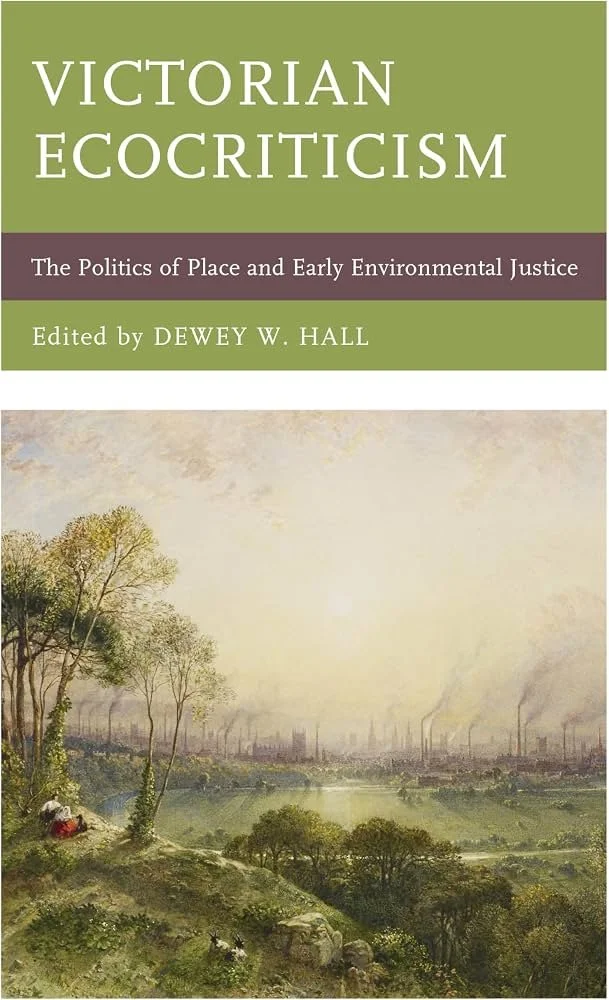
Review of Dewey W. Hall, ed., Victorian Ecocriticism: The Politics of Place and Early Environmental Justice
Originally published in Green Letters in 2017
While as recently as 2015 Jesse Oak Taylor could, somewhat wryly but also justifiably, pose the question ‘Where is Victorian Ecocriticism?’, the last few years have seen the intersection between Victorian studies and ecocriticism develop into a vibrant field of enquiry. A growing number of monographs, journal special issues, and essay collections examining Victorian culture and literature in relation to ecological questions have happily furthered the existent body of scholarship and made the subject far more visible within Victorian studies (although, as readers of Green Letters are likely to agree, ecocritics have been engaging with Victorian literature for some time now). The maturation of Victorian Ecocriticism has also meant that we are now seeing work attend to specific critical or thematic subfields of ecocriticism. Dewey W. Hall’s new edited volume Victorian Ecocriticism: The Politics of Place and Early Environmental Justice joins this emergent trend. Focusing on the dual subjects of environmental justice and the politics of place, it collects nine essays that, by ‘delving into […] texts by Victorian writers’, look to ‘uncover evidence of early environmental justice linked to place’ (8).
As Hall sets out in his concise if rather perfunctory introduction, the term ‘place’ should be understood as the ‘schema’ through which humans ‘make sense of the space’ around them, whether that be mountains, the ocean or urban slums. By extension, the ‘politics of place’ is the ‘web of interrelations’ that emerges from those sense making activities (6-7). Given that the Victorian era was the period that helped to write the blueprint for industrial capitalism, rampant urbanisation and toxic pollution, it is unsurprising that nineteenth century literature is well-positioned to historicize and theorize ecological questions around place and justice. Indeed, the volume excels in bringing to light previously unremarked upon aspects of both canonical and lesser studied Victorian texts that speak directly to matters that continue to shape environmental discourse. Chapters on Charles Dickens, Charlotte Brontë, Charles Kingsley and Thomas Hardy offer ecocritical readings of canonical novels that innovatively reframe familiar texts. Jillmarie Murphy uses attachment theory to understand identity and rural life in Tess of the d'Urbervilles, Akemi Yoshida attends to the tension between theology and ecology in Kingsley’s The Water-Babies, and Adrian Tait takes a material ecofeminist approach to Brontë’s Jane Eyre. Meanwhile Hall contributes a chapter that examines the representation of industrialism in Dickens’s Hard Times, while Michelle Deininger and Natalie Rose Cox offer an ecogothic reading of Elizabeth Gaskell’s short fictions.
The strength of this volume, and what I suspect will be of especial interest to Victorianists, is the chapters that either draw on archival material or examine overlooked texts so as to nuance our understanding of well-known figures. Saeko Yoshikawa consults a rich array of newspaper articles, letters and forgotten popular poems in her historical analysis of how Wordsworth’s anti-railway sentiments were appropriated in the later nineteenth century by proto-environmentalists who saw the railways as a means of protecting the Lake District. Julie M. Barst also presents a new side to a canonical figure, interrogating Anthony Trollope’s little-studied books on Australia to convincingly show how Victorian writers codified ‘the British center’s refusal to recognize and react to widespread human rights disasters and ecological ruin in the colonies’ (106). Similarly, Green Letters’s own Reviews Editor Sue Edney contributes a chapter on Philip Henry Gosse which focuses on his tenure on the island of Newfoundland, where he helped process seal hides collected during the island’s bloody and violent hunting season. Situating Gosse’s published books and unpublished notebooks alongside both contemporaneous accounts of Newfoundland’s fishing industry and Rob Nixon’s concept of slow violence, Edney’s chapter sheds new light on Victorian ideas of environmental stewardship.
While the book amply succeeds in historicizing it subject, it does not always do such a good job of theorising how notions of place or justice are present in Victorian literature. While recent ecocritical theory by critics such as Ursula K. Heise and Timothy Clark have problematized earlier eco-phenomenological approaches and opened up new modes of thinking about place, with one or two exceptions, the notion of “place” in the volume follows Hall’s rather simplistic definition of ‘place consciousness [as] an awareness of the local that is intricately linked to the self and beyond the self’ (6). In certain chapters this becomes particularly problematic. Marlee Fuhrmann’s analysis of the way in which soil is figured in Henry David Thoreau and Frank Norris takes an original approach to her subject. Yet, the incessant focus on how these writers make the reader conscious of ‘the earth beneath [their] feet’ (161) is wholly premised on a model of place-consciousness that hedges all its ecological bets on the idea that becoming attuned to our locality will produce a better tomorrow (it is notable, too, that the rather dubious connections between national identity and soil in the nineteenth century goes unmentioned). As recent ecocritical theory has pointed out, this approach takes for granted that the human way of perceiving the world is the normative or default scale. Fuhrmann’s approach is not alone in this; there is a tendency throughout the volume to identify and affirm moments of heightened place consciousness in Victorian texts as facilitating the recognition of the ‘inherent value of nature itself’ (25) or presenting a ‘deep regard for nature’ (168). Except for a small number of chapters that are more critical in both their approach and vocabulary, such as Barst’s and Edney’s respective attention to the discord between colonial centres and peripheries, the lack of theoretical engagement with what constitutes place or justice is somewhat of a missed opportunity. Related to this, the concept of the Anthropocene might have been given more attention. Given that the Anthropocene poses fundamental challenges to both the politics of place and environmental justice, and given the fact that there is a large body of work proposing that the Anthropocene is in many respects a Victorian phenomenon[1], the absence of any analysis of how Victorian literature might already be historicizing and theorizing this emergent epoch contributes to the sense that, in a number of respects, the volume is not quite at the forefront of the critical conversation around the politics of place or environmental justice.
Instead, the value of Victorian Ecocriticism is to be found in the way it reveals new ecological dimensions of familiar writers whose work has not yet received the ecocritical attention it deserves. Covering a fairly broad sweep of canonical Victorian writers, the ecocritical readings of often taught texts will be a useful pedagogical resource for those looking to introduce an ecocritical approach to how they teach Victorian literature. Similarly, the chapters that draw on archival research and lesser studied texts are well positioned to intervene in our critical understanding of figures such as Wordsworth, Gosse and Trollope. While those who turn to the volume hoping to find new ideas about how we think about the politics of place and/or environmental justice are likely to be disappointed, the volume nonetheless contributes to the growing body of work that challenges how we read and write about Victorian literature.
[1] Timothy Morton, writing elsewhere, has gone so far as to argue that the Anthropocene ‘means that we are still inside the Victorian period, in psychic, philosophical, and social space’ (489).