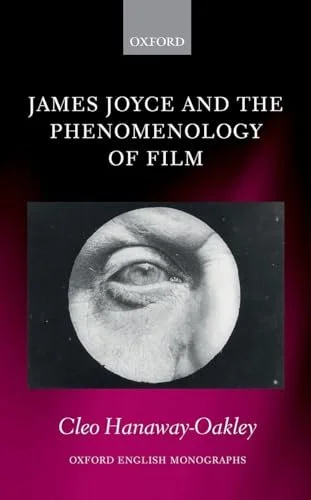
Review of Cleo Hanaway-Oakley, James Joyce and the Phenomenology of Film (Oxford University Press, 2017)
Originally published in Textual Practice
On Monday 20th December 1909, a then little-known writer called James Joyce opened the Volta Cinema, Dublin’s first dedicated cinema, close to the city’s busy Sackville Street. Although Joyce only ran the cinema for a handful of months before returning to Trieste, it represented his growing interest in the medium of cinema and, as Cleo Hanaway-Oakley suggests in this new study, his job as a cinema manager would have likely exposed him to the film trade journalism of the day which, among other subjects, featured writing on emergent theories of film philosophy. In this monograph on Joyce and film, Hanaway-Oakley presents the ‘parallel philosophies latent within early films themselves, and within Joyce’s texts and the experience of reading Joyce’s texts’ (p.3). Not a study of the influence of cinema on Joyce, nor an attempt to establish analogies between cinematic techniques and Joyce’s writing, Hanaway-Oakley’s study instead looks to outline the shared philosophical concerns around subjectivity, materiality and technology as they were expressed in Joyce’s fiction and early cinema culture. Approaching her subject through the phenomenology of Maurice Merleau-Ponty and contemporary film theory, Hanaway-Oakley challenges the prevalent view of modernism and cinema that reads both in terms of impersonality and detachment, arguing instead that we find in both Joyce and early film a philosophy of embodiment and connection.
As the title suggests, this is not so much a study of Joyce in relation to the philosophy of film, but rather the phenomenological branch of philosophy that, for Hanaway-Oakley, is best represented by the works of Merleau-Ponty. Although Merleau-Ponty’s main works were not published until after Joyce’s death, Hanaway-Oakley suggests an affinity in their shared interest in ‘exploring the conscious perception of the world-as-it-is-lived’ (p.2) and their overturning of a dualistic relation between the mind and the body in favour of an embodied understanding of subjectivity. Joyce’s early appraisal that ‘cinematographic images act like those stimuli which produce a reflex action of the nerves’, an idea which he scribbled down in a notebook at some point between 1907 and 1909, becomes something of a cornerstone for the study, underpinning the argument that for Joyce cinema is always an embodied experience to which we respond to physically, as well as emotionally. For Hanaway-Oakley this is why a Merleau-Pontian phenomenology offers a particularly rich way of thinking about the philosophy of cinema alongside Joyce. In contrast to the subject-object dichotomies found in psychoanalytical approaches to cinema, in which the audience member’s relationship to film is premised on absence and detachment, Hanaway-Oakley finds in Merleau-Ponty a philosophy that instead hinges on intersubjectivity and reciprocity, in which there is a ‘melding of the binaries’ between self and other, subjectivity and objectivity (p.13). This melding, the book argues, speaks more directly to the presentation of subjectivity that we find in Joyce’s texts, especially Ulysses, bringing to light the cinematic and phenomenological dimension to Joyce’s literary output.
The study is organised into four chapters, each of which take a philosophical theme that Hanaway-Oakley identifies in both Joyce and phenomenology. After a short introduction, the first chapter, entitled ‘Reciprocal Seeing and Embodied Subjectivity’, sets out the key claims of the study. Briefly surveying the critical history of Joyce and film studies, the chapter turns in more depth to the way in which Merleau-Ponty can be seen to have developed a ‘phenomenology of film’ (p.18), situating the concepts he developed to explain how our relation to the world is always embodied (such as “gestalt”, “attention” and “intention”) in relation to the films and film theory of the early twentieth century. It is in this second respect that the study makes one of its most convincing and original arguments, making a strong case for the way in which phenomenology opens up new ways of thinking about the materiality of early twentieth century cinema and its relation to literature, and challenging the conventional aesthetic register through which we understand modernist cinema. The second chapter, which turns in more detail to early twentieth-century philosophers of perception, particularly Bergson, continues the study’s elucidation of modernist philosophy in relation to film, historicising its development while also drawing out its nuances. Hanaway-Oakley’s ability to concisely and clearly explain difficult philosophical concepts is particularly impressive here. Teasing apart Bergson’s vitalism, she establishes a dialogue between Bergson’s theory of the image and Merleau-Ponty’s later concept of “flesh”, suggesting that in the latter we find a ‘more bodily and more subjective’ theory of perception (p.41) and the basis for understanding both film and literature through a model of perception that goes beyond mental cognition. The ‘Penelope’ episode of Ulysses, Hanaway-Oakley argues, in which ‘thoughts, objects, place, memories and bodily sensations’ are all interwoven, presents us with a ‘proto-phenomenological’ correlate to the philosophy of perception that Merleau-Ponty would later articulate.
This revisionary reading of modernist philosophy and cinema through a Merleau-Pontian phenomenology gives the study a clear pertinence beyond its focus on Joyce and it is well-positioned to make an intervention in modernist studies more broadly. Yet the study’s broad ranging focus and the relative lack of sustained attention given to Joyce in these opening chapters might disappoint those coming to the text hoping for extended analysis of his texts, and, indeed, it does feel somewhat at odds with the book’s title. The last two chapters, however, offer more of a focus on Joyce and present a stronger case for why his work in particular demands to be read alongside a phenomenology of modernist cinema. In the chapter ‘Machine-Humans and Body-Subjects’, Hanaway-Oakley looks at anxieties around humans as machines in the early twentieth century. In the slapstick of Charlie Chaplin, where humans take on the appearance of automatons, and in the humour of Ulysses, where objects are repeatedly endowed with human qualities, Hanaway-Oakley argues that we find an articulation of the way in which rather than existing in binary opposition, humans and machines are ‘interlinked in a variety of ways’ (p.76) and the machine becomes a way of understanding human life.
The final chapter, ‘Tactile Vision and Enworlded Beings’, offers the strongest readings of Ulysses. Focusing on tactility and proprioception (the bodily sense of position within and movement through space), Hanaway-Oakley looks at the thematic and formal presence of cinematic technologies in Joyce’s novel. Here, we get a reading of both Stephen Dedalus’s and Bloom’s interiorities in terms of the perspective-altering technology of the stereoscope (a pre-cinematic device that produced a three-dimensional still image) and a reading of the ‘Wandering Rocks’ episode of the novel that draws parallels with “phantom rides”, a sub-genre of film in which cameras were fixed to moving vehicles and the viewer experienced a sense of movement as they watched. Having drawn parallels between Ulysses and these and other film technologies, the study then scales back to suggest a whole new way of understanding the relationship between the reader and Joyce’s text: Ulysses becomes ‘a screen—one that reflects us, admits us, and … [forces] us to pay “attention” in the Merleau-Pontian sense of the word’ (p.113). This is followed by a short conclusion that gestures towards the implications of film and phenomenology for Finnegans Wake (largely undiscussed elsewhere in the book) and considers the circumstances around the first proposed film adaptation of Ulysses, which Joyce read the script for in the 1930s, but which was never made.
Despite its short length (it is just under 150 pages long), James Joyce and the Phenomenology of Film never feels hurried or lacking in examples to justify its main thesis. Indeed, the breadth of material that is drawn upon in the construction of its arguments is impressive, from early theoretical writing on cinema to early films themselves (illustrated with some wonderful accompanying photographs), while the handling of both Joyce and Merleau-Ponty is careful, judicious and convincing. There are times when the picture of early twentieth century continental philosophy would have benefitted from being further developed (Husserl’s and Heidegger’s very different phenomenological configurations of subjectivity get little more than a mention) and the description of other philosophers, such as Bergson, as ‘proto-Merleau-Pontian’ (p.43), occasionally gives the impression that all roads lead to Merleau-Ponty. Yet, these feel like relatively minor points in light of the book’s strengths. Reading Joyce back through a highly original synthesis of phenomenology, early cinema and film theory, this is a genuinely comparative study that challenges longstanding ideas around modernism and film, and points the way towards future studies of literary modernism that bring together history, philosophy and non-textual media forms.