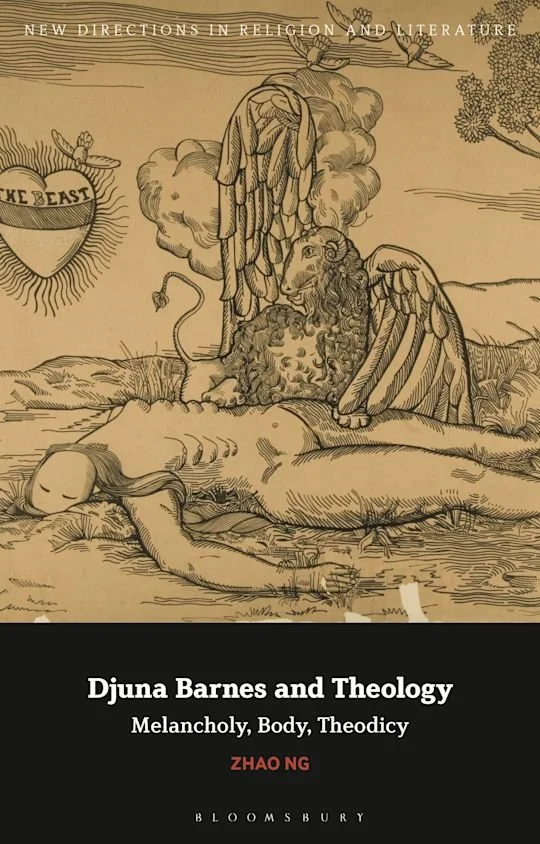
Review of Zhao Ng, Djuna Barnes and Theology: Melancholy, Body, Theodicy (Bloomsbury, 2022)
Originally published in Textual Practice.
Melancholy is a word that certainly springs to mind when thinking of Djuna Barnes. The ‘melancholy’ that is ‘hidden beneath every jest’ of Mathew O’Connor in Nightwood (1936) could just as easily be taken as a description of Barnes’s modernist style, where wit and humour often conceal a more moribund sentiment. Theology, on the other hand, seems less immediately self-evident for such an irreligious writer. Yet, as Zhao Ng’s wide-ranging new monograph shows, not only are both terms equally important when trying to understand Barnes but, moreover, they demand to be understood together. Recontextualising Barnes’s work within a moment of ‘existential predicament’ (p.3) at the turn of the twentieth century, Ng frames modernist alienation in terms of an onto-theological crisis in which secularisation intensifies rather than alleviates spiritual anxieties. In the early twentieth century, Ng argues, theodicy, or the attempt to vindicate God ‘given the manifest evidence of suffering and evil in the created world’ (p.9), is internalised within a post-secular culture, where religion, literature, psychoanalysis and philosophy compete to make sense of suffering and existence. The result is that ‘melancholy’ becomes the condition of ‘modern subjectivity’ (p.x) as a melancholic disposition is both informed by and, in turn, shapes questions of existence.
Djuna Barnes and Theology situates Barnes as a writer whose oeuvre is ‘stalled before an existential […] “yes” or “no” to the Creator and Creation” (p.52) and who is actively wrestling with the question of whether any meaning or value can be salvaged from the horror of existence. While, as Ng acknowledges, Barnes was not a practicing Christian, she was writing at a point in time where metaphysics was revising (as opposed to rejecting) ideas from theology. Barnes’s body of work, Ng proposes, offers an aesthetic judgment on life that invites itself to be understood in terms of a ‘weak theodicy’, where a ‘basic reconciliation with existence, a positive judgment on life in spite of evil and pain’ might potentially result in a ‘modest, indeed minimal, threshold for the vindication of life’ (pp.17-18). Mapping theodicy onto literary forms, with comedy serving as a vindication of life and tragedy as its pessimistic counterpoint, Ng’s monograph suggests we can see both responses in Barnes’s oeuvre. This schema informs the book’s structure in which after an introduction and a first chapter that offers a further exposition of Barnes’s approach to melancholy and theodicy, there are two chapters on comedy (focusing on the Ladies’ Almanack [1928] and Ryder [1928]) and then two subsequent chapters on tragedy (focusing on Nightwood and The Antiphon [1958]). Although Ng nowhere explicitly states it, the result is a chronological account of Barnes’s life and work that suggests a movement from comedy to tragedy and from a minimal reconciliation with existence to a bitter, painful rejection of it.
One of the book’s major strengths is the way in which it draws on an extensive range of archival materials to develop its analysis. Contributing to the archival turn within studies of Djuna Barnes, there is an astonishing amount of material published here for the first time. These materials include biographical documents that help us better understand the sensibility of the person behind the work, including an apparent (failed) suicide note from 1938 and correspondence from Barnes’s 1948 stay in a sanatorium where she was diagnosed with ‘general melancholia’ (p.1). Ng draws extensively on Barnes’s letters, showing them to not only help better understand the published works, but as rich and significant documents in their own right (and making it all the more frustrating that they are not yet readily accessible outside of her archive at the University of Maryland). Barnes’s personal library is also the site of new discoveries. Ng also makes use of Barnes’s personal library, highlighting passages that she annotated in her copies of Proust, Nietzsche, Dostoevsky and others, and joining the dots with discussions of literature, art and philosophy in her correspondence (especially with Emily Coleman). Startling new intertextual discoveries are made along the way. O’Connor’s assertion in Ryder that the most wilful act of defiance against God is, paradoxically, to take one’s own life, is, for instance, shown to be a refashioning of a sentiment by Kirillov in Dostoevsky’s The Devils (1872), a book which Barnes read, annotated and discussed.
Theory is equally important to Ng’s approach to Barnes and the rich use of archival material is used alongside a refined theoretical framework that develops the book’s central focus on theodicy. The chapter on Ryder, mentioned above, suggests that on one level the novel develops Nietzsche’s amor fati to direct a hollow, cynical laughter at the cultural acceptance of sexual violence against women, while also encoding an irony that, akin to Adorno’s political critique of Nietzsche, produces the potential for a dialectical movement that keeps the future open. Insightful as it is convincing, the chapter succeeds in finding a new way of understanding the novel’s cruel comedy while not attempting to rescue Ryder from the aspects of it which are troubling to a modern readership. While Ryder is seen as future-orientated, the Ladies Almanack is seen as creating an ‘achieved eschatology’ or a utopia-in-the-present (p.86). Taking a Deleuzian understanding of aesthetic sensation, Ng argues that the privately printed book doesn’t just offer a joyous satire of the queer Left Bank coterie she was part of, but through form and language emits a kind of affective sensuality on the page, with the work itself serving as a site of lesbian pleasure (although it is not always entirely clear how this translates in empirical terms, with claims around how Barnes’s ‘style ontologizes sense’ remaining somewhat vague [p.77]). As with Ryder, Ng identifies a weak affirmation of life in the Ladies’ Almanack’s ‘utopian response to the situation of the melancholic subject’ (p.73).
The second half of Barnes’s writerly life is couched in terms of the tragic, beginning with Nightwood. Focusing largely on O’Connor, Ng takes Lacan’s understanding of narcissism to suggest that the characters in the novel fixate on an ideal or transcendent image of the self, which they become ‘impaled’ upon (p.125) and which the body continually ‘fails to assume’ (p.125). O’Connor’s troubled ‘transfeminity’ (p.123) is presented as the counterpoint to the fascist body of the Aryan nation in this respect; both are different aspects of a self-destructive narcissism. Throughout the monograph, Ng doesn’t really engage in a dialogue with the field of Barnes studies (despite the occasional sweeping statements about it) and this was one chapter where it felt like it would have been beneficial. It wasn’t clear to me, for instance, how Ng’s argument about psychoanalysis, fascism and narcissism differed in the final analysis from Jane Marcus’s field-forming essay on Barnes’s ‘modernism of marginality’ or how it developed Erin Carlston’s important work on fascism and modernism, which looks at Nightwood in some detail. One of the book’s successes, however, is not to position Nightwood as the pinnacle of Barnes’s career and the final chapter on The Antiphon which follows is one of the book’s clearest strengths. In a strikingly original reading of Barnes’s late verse-drama, Ng shows how the play enacts a biting rejection of materialism and sublimation as so much ‘libidinal falsities that make up the history of human civilization’ (p.159). Existential guilt is the condition of our arrival on the stage of being, producing a world of lack, hunger and fixation for which, Ng argues, Barnes offers no solution.
Djuna Barnes and Theology is written with verve and style, and its breadth of theoretical and theological frameworks is breath-taking, at times challenging the reader to keep up (theological terms are often used without definition or gloss, while the use of untranslated Latin and modern European languages make similar expectations on readers). And while Ng acknowledges that the schematised approach doesn’t necessarily align with the turn to ‘weak theory’ within modernist studies (p.18), this would be less of an issue if the book’s theoretical framework was slightly more coherent. Beginning by anchoring the book in Heideggerian phenomenological hermeneutics and rejecting symptomatic readings, the arguments that follow are surprisingly dependent on (at various points) psychoanalysis and dialectical reasoning, with the disjuncture between the different accounts of the subject, subjectivity and existence within these different approaches not always readily engaged with. The result is a book with a heavy and not always entirely balanced theoretical apparatus, with the validity of its finer points likely going to rest on the reader’s willingness to accept the onto-theological point being made at any given moment.
The monograph is published in Bloomsbury’s New Direction in Religion and Literature series and part of the ambitiousness of the monograph is its commitment to making an intervention in theological reasoning as much as to produce a new scholarly account of Djuna Barnes. The book’s short conclusion raises the question of the existential threat that faces us in a post-Holocaust secular age where we face new forms of judgment against our species as a whole (p.180). Art will continue to be pivotal since, as Ng shows throughout the monograph, it is ‘in the last instance, an aesthetic judgment on life’ (p.27). Our understanding of Djuna Barnes’s art is greatly enriched by this major new study of her life and work, one of only a handful of monographs on the author in the last decade or so. Offering a range of generative and convincing new readings, Ng draws attention to the aspects of Barnes that might continue to jolt us into rethinking what it means to accept or reject life in the twenty-first century.