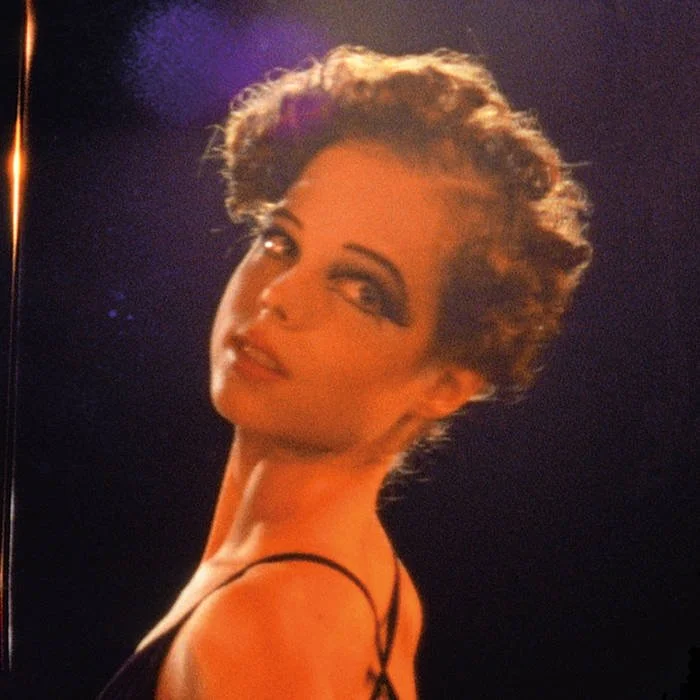
Delia Gonzalez: In Remembrance
DFA Records, 2015
Delia Gonzalez is probably best known in dance music circles for her work alongside Gavin Russom producing leftfield house and ambient music in the early 00s. Since then she has focused her efforts on commissions that straddle the worlds of club music and fine art. In Remembrance, Gonzalez's first album as a solo artist, arrives as the culmination of her most notable project in the last half-decade: a quarto of solo piano compositions that were written to soundtrack four 16mm ballet films first exhibited at the Galleria Fonti in Naples in 2010 and subsequently exhibited in Cologne and New York. Accompanying these piano pieces are four techno reworkings courtesy of up-and-coming producer Bryce Hackford.
Haunting feels like an obvious adjective to reach for when describing Gonzalez's music. A sparse and relatively simplistic melodic refrain loops over and over, the soft thud of piano hammering between notes. A second melodic refrain joins the first. The track works through a juxtaposition of lightness and heaviness, an aesthetic that becomes further pronounced in 'II' where flitting keys work in contradistinction to one another, not quite synchronising but instead building to intense, uneven crescendos. The result is as hypnotic as it is unnerving.
Unlike other noted crossover pianists, such as Nils Frahm or Jon Hopkins, Gonzalez doesn't offer airy or spacious compositions; rather there is a subtle forcefulness to her music that is arguably more provocative and incendiary than either of the aforementioned. In the falling notes of 'III' which seem to tumble down the scales before being picking themselves up again and starting all over, or in the ebbing tempo that dictates the urgent pace of 'IV', where everything seems on the point of disintegration, there is none of the easy-going ambience often associated with modern classical. Instead, as the pieces expand outwards and become gradually more layered, they make demands of the listener. Yet, whilst in words this might make Gonzalez' music sound difficult, bound up with the pretensions of the avante-garde, the listening experience could not be more different. The four pieces here are immersive and surprisingly easy to listen to.
It might seem odd to combine ballet pieces and techno tracks, but not only does it work but in fact there is not even an insinuation of disjuncture between the two halves. This is partly thanks to the fact that Gonzalez' way of writing for the piano remains indebted to the sound design of electronic music. It's also partly because Hackford's first 'Remix I' is an ambient affair in which the key swirl slowly in a warm wash of reverb and soft electronics, easing the listener into the more raucous second half of the album. 'Remix II' steps things up, introducing an elastic kick drum that transforms Gonzalez' melody into a slice of deep sci-fi techno. But it's the final two remixes where Hackford's talents really shine. 'Remix III' is thirteen-minutes of muscular leftfield techno in which shimmering keys entwine with stuttering kicks, punctuated by an angular bassline. 'Remix IV' follows suit, drawing the album to an impressive close with stringy chords and dusty pads. Hackford’s techno remixes not only work to give Gonzalez' album a curveball second half, injecting it with a steroid shot of 4/4 beats, but further draw out the melodic themes of melancholia and ecstasy that colour her melodies.
This is a record that slots into the exciting things happening in the fields of modern classical and analogue techno, and yet simultaneously stands on its own. It sounds like absolutely nothing else that has been released this year.
Review originally published by Inverted Audio.
Tracklist
1. I
2. II
3. III
4. IV
5. Remix I
6. Remix II
7. Remix III
8. Remix IV