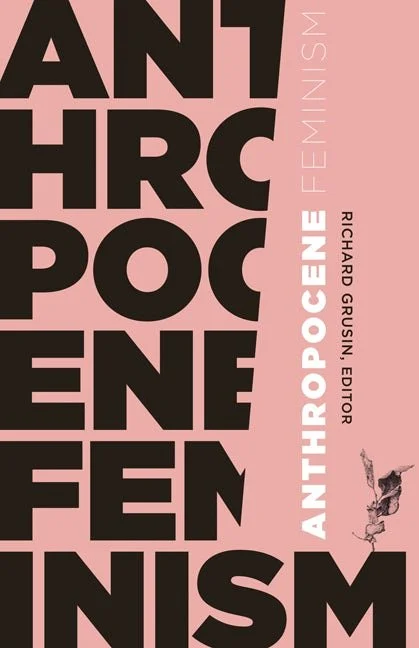
Review of Richard Grusin, editor, Anthropocene Feminism (University of Minnesota Press, 2017)
Originally published in Green Letters
Writing in The Guardian in 2014, the economist Kate Raworth suggested that the Anthropocene might be renamed the Manthropocene if the initial gender imbalance of the scientists who made up the Anthropocene Working Group was anything to go by (29 men to 1 woman). These leading scientists might be adept at measuring the ways in which the planet is increasingly at the mercy of human activities but they ‘seem oblivious to the fact that their own intellectual deliberations are bizarrely dominated by white northern male voices’. Moreover, it is not just the gender of scientists that has raised concerns about implicit gender biases surrounding the Anthropocene. As Richard Grusin writes in the introduction to this new volume of essays, there is a ‘too often unquestioned masculinist and technonormative approach’ to the way in which the Anthropocene is conceptualised, both in the sciences and the humanities. Questions of sex and gender, along with intersecting questions of race and class, have all too often been overlooked despite the fact that, as Raworth’s article makes clear, they influence the ways in which our new planetary epoch is being researched.
It is at precisely this juncture that Anthropocene Feminism looks to make an intervention. Originating in the 2014 annual spring conference at the Center for 21st Century Studies (C21) at the University of Wisconsin-Milwaukee, Anthropocene Feminism is premised as an ‘experiment’ to ‘bring the Anthropocene together with feminist theory to see what might result from the interactions among these competing conceptual formations’. The collection, comprised of nine contributions from leading feminist thinkers from different fields and disciplines, aims to offer a variety of responses to the question of what it means to practice a feminist critique that speaks to climate change and planetary degradation.
The first five essays in the collection broadly fall under the category of critical theory. Poststructuralism and posthumanism emerge as twin poles of reference here, albeit not always deployed in an unequivocal fashion. Claire Colebrook’s provocatively titled ‘We Have Always Been Post-Anthropocene’ opens proceedings. Like many of the essays in the volume, Colebrook begins from a position of scepticism regarding claims as to the universality of the Anthropos who names an epoch after himself and instead suggests that the operative question to ask is ‘whose Anthropocene?’ Locating the way in which the Anthropocene is bound up with a history of sexual difference (for instance in the co-emergence of the nuclear family and industrialism) Colebrook proposes the necessity of examining where the moments of difference that produced the Anthropocene occurred and, conversely, asks if and how a different history might have produced a different outcome. Offering two counter-factual histories (one in which humanism and, therefore, industrialism did not occur; the other in which humanism and industrialism did occur but of an ecologically friendly kind), Colebrook reasons that what both reveal is not how we might have avoided the Anthropocene, but rather how the concept of the Anthropocene itself might be the problem, since it ‘maintains a notion of stabilized nature, a nature that is ideally there for us.’
In a similar vein, Rosi Braidotti asks how the antihumanist advances of poststructuralism might be refashioned for a feminist Anthropocene. Playfully riffing on Dipesh Chakrabarty’s influential article, ‘The Climate of History: Four Theses’, Braidotti argues four theses for feminism in the Anthropocene: 1) that feminism is not a humanism, but necessarily posthumanist, 2) that Anthropos should be off-center, in the sense that we should actively disrupt ‘century-old anthropocentric habits’ 3) that Zoe, or a vitalist concept of life, should be the ruling principal in how we think about the nonhuman, and 4) that sexuality is a force beyond gender and should instead be conceptualised as the ‘vital force par excellence’. Elizabeth A. Povinelli’s chapter ‘The Three Figures of Geontology’ follows. Like Bradotti, who argues that mounting questions around the ethics of extinction should impel us to rethink the philosophy underpinning our feminist politics, Povinelli asks how Foucault’s model of biopolitics might be adapted in an epoch where conventional notions of death are under erasure.
Foucault, perhaps surprisingly, emerges as a common point of reference in these opening essays, with Lynne Huffer’s chapter also drawing on his work. Opening with a polemical assessment of the vitalist and new materialist methodologies through which feminism has approached both biological and ecological questions in recent years, Huffer critiques what she identifies to be the transhistorical conception of life within feminist theory. Huffer instead argues that, in the face of the sixth great extinction event, we need Foucault’s epistemological critiques of life, sex and materiality more than ever. Demonstrating the divergence of views and positions within the collection, the following chapter comes from Stacy Alaimo, one of the key proponents of the material ecocriticism whose methodology Huffer is so critical of. Alaimo’s chapter, however, argues for a focus on ‘onto-epistemologies’ that would synthesise the insights of new materialism with the kind of epistemological inquiries that Huffer sees as lacking in feminism’s ontological turn. Turning her attention to the ways in which the Anthropocene has tended to be visually represented, Alaimo argues that, as opposed to the largescale, technologically sublime images of sprawling industrial domination over the planet, a more environmentally effective aesthetic might be found in the psychedelic-like ‘photos and videos of dissolving shells […] portraying the shift in [ocean] alkalinity’. While Alaimo’s rejection of the disembodied scale at which the Anthropocene tends to be conceptualised feels both convincing and urgent (her critique of Chakrabarty is one of several in the book), the weight she lends to the experience of seeing vivid images of ‘delicate shell[s] dissolving’ nonetheless perhaps risks overstating the efficacy of individual intentionality in an era characterised by unintended consequences of collective actions.
The final four chapters are more interdisciplinary in nature. Myra J. Hird and Alexander Zahara co-author a chapter that examines human waste within the context of colonialism. Offering a case study of the Eastern Canadian Arctic city of Iqaluit, where the legacy of colonial industrialism has left huge contaminated waste sites, abandoned mines and poisoned soil and water, Hird and Zahara make the case that the cultural and material concept of “waste” was introduced by colonists into an Inuit culture where notions of refuse and abjection were not prevalent. Arguing that Chakrabarty’s universalised ‘characterization of sovereignty’ is one which Inuits would not recognise since they hold a different configuration of the relation between the human and the nonhuman, the chapter offers a convincing postcolonial feminist critique of the Anthropocene’s universalising tendency. Joshua Clover and Juliana Saphr also articulates postcolonial concerns in their turn to the question of poetry and capitalism in the Anthropocene. Giving a striking reading of the eighteenth-century Hawaiian poem Kumulipo, an oral epic that charts the emergence of life on earth, Clover and Saphr emphasise the ways in which the poem adapted to and was co-opted by the all-consuming energies of global capital (the poem was chanted to James Cook on his landfall at Hawai’i). In contrast, Professor of earth science, Jill S. Schneiderman, sheds light on what it means to practise feminism within the sciences. Schneiderman gives a history of the Anthropocene’s emergence within the disciplines of geology and geophysics, before revisiting the nineteenth century to offer parallels between the rush to name geological eras in Victorian England and our current moment. Balancing detailed scientific analysis with a historical overview of knowledge practices, Schneiderman’s essay is one of the strongest in the collection. The final chapter comprises a dialogue between the artist Natalie Jeremijenko and philosopher Dehlia Hannah. Ranging over subjects such as the relationship between laboratory experimentation and performance art, the co-participation of other species in producing art, and the way in which art can pose a critical intervention in everyday life, the chapter is a fittingly provocative ending to a book premised on provocation.
The breadth of responses to the Anthropocene here forestalls any argument that feminism might only offer a narrow or niche approach to questions of planetary change. Instead, what emerges (contrary to Grusin’s framing of the book as an experiment bringing two distinct concerns into dialogue) is that the Anthropocene cannot be rigorously addressed without attending to questions of sex and gender. In short, this collection makes clear that the Anthropocene needs feminism. The heterogeneity of responses here makes for a fantastic starting point. Feeling less like the edited highlights of a conference proceedings than a ready-made anthology, Anthropocene Feminism seems destined to be part of the critical discussion around planetary change for some time to come.