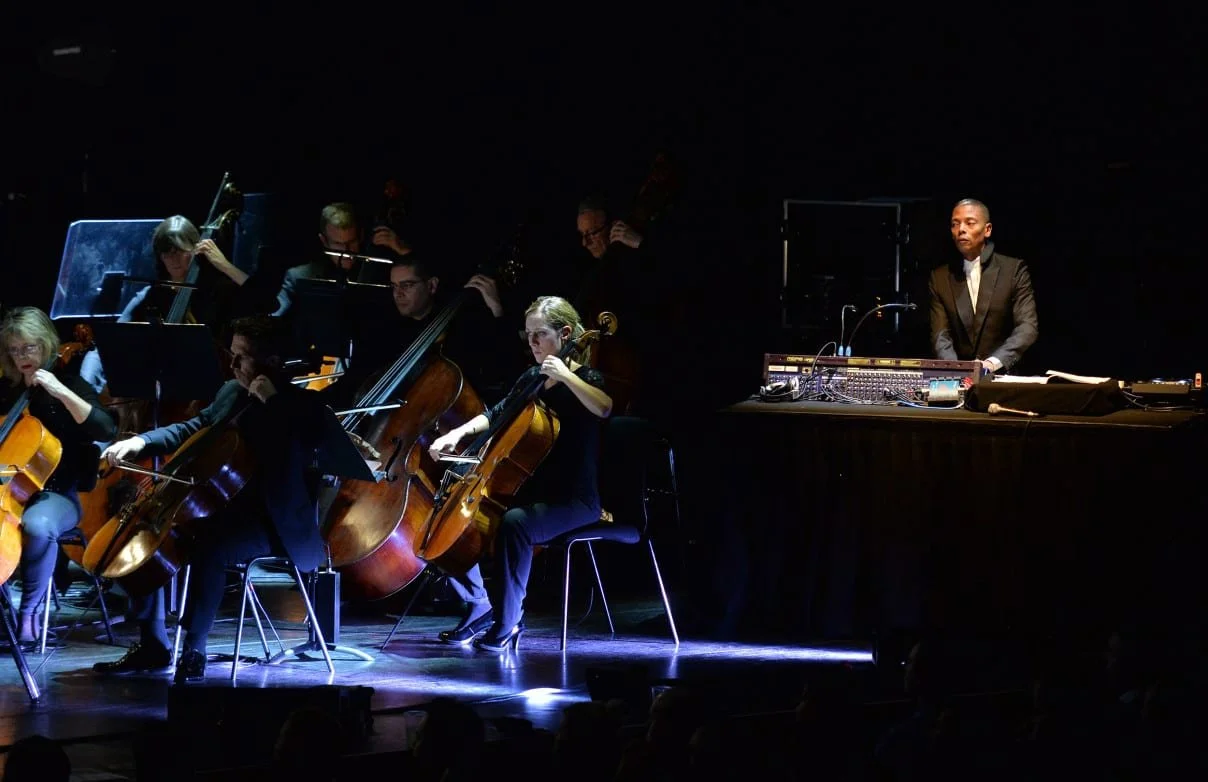
Jeff Mills: Light from the Outside World at the Barbican (24 October 2015)
Originally published by Inverted Audio. Photo supplied by Mark Allan.
In 1994 the American cultural critic Mark Dery coined the term ‘Afrofuturism’ to describe the way in which African-American themes in music and literature were appropriating ‘images of technology and a prosthetically enhanced future’. Artists like Afrika Bambatta and Sun Ra, Dery asserted, had established an aesthetic that was shaping ideas of black identity around space travel, cosmology and techno-utopias. Despite Dery’s surprising initial oversight of Detroit techno, Jeff Mills’ extensive body of work – both his discography and his live shows – have come to be seen to occupy an important electronic strand in Afrofuturism and perhaps no aspect more so than his full-scale orchestral performances. Beginning a little more than a decade ago with a monumental performance with the Montpelier Philharmonic Orchestra, Mills’ work with various world-class orchestras has allowed him to take his angular, full-bodied brand of techno and draw out its futurist themes on a grand scale.
Mills, who of the first wave of Detroit producers has shown the most sustained interest in transhumanism and technology, has been well suited to performances where large banks of swelling strings, woodwind and brass go up against and are reshaped by his rapid fire machine manipulation. Moreover, as the finely dressed Mills tells the Barbican audience tonight at the UK premier of ‘Light From The Outside World’, these existential and technological themes are explicit in the work’s conception. Tonight’s performance with the BBC Symphony Orchestra, Mills explains, derives from his own ideas about the nature of reality (and no doubt, although unmentioned, his well-known interest in extra-terrestrial life). As such, ‘Light From The Outside World‘ comprises tracks from his back catalogue that took Mills the “furthest away from himself” when he was writing them.
The reimagined versions of favourites such as ‘Gamma Player’, ‘Imagine’ and ‘Amazon’ are overwhelming in their conversion into orchestral arrangements, whilst also drawing out (and adding) the nuances within Mills’ original productions. The effect is perhaps at its most pronounced and effective in the long, atonal build-up that precedes tonight’s performance of ‘Sonic Destroyer’, the orchestra teasing the audience into an almost unbearable sense of anticipation.
And whilst there might be gaps for applause between each track, much thought has clearly gone into the sequence and transitions. The movement from the romantic, wholly orchestral opening number and the freneticism of ‘Gamma Player’ establishes utopian overtones that incrementally morphs into something dark, more techno-dystopic sounding, reaching its climax in the schizoid finale of ‘Sonic Destroyer’ and (what else) ‘The Bells’.
The BBC Symphony Orchestra, soaked in deep reds and crystalline blues lighting, appears well within its comfort zone translating Mills’ terse techno-topias into classically structured, cinematic arrangements. Conductor Christophe Mangou impresses in similiar fashion. Even the occasional moments of dissonance between the orchestra and Mills’ work on the drum machines add to the pieces and the show’s over-all effect, rather than detracting from it.
The crowd, however, are less certain of themselves. Clearly wishing that they weren’t restricted to the formality of the Barbican and its concert seating, by the time the sawing strings and thundering beats of ‘The Bells’ arrive a large proportion of the audience have liberated themselves. Dancing on their seats and in the aisles, the audience pump their fists and accompany the large orchestral bells with their cheers. This, you can’t help thinking, must be a kind of ovation that the BBC Symphony Orchestra doesn’t see every day.
If there’s any nit-picking to be made, it’s the choice of final track. Addressing the audience again, Mills explains how in the mid-1980s Ashford & Simpson’s ‘Bourgie Bourgie’ not only became a staple at house parties, but came to exemplify the “transition” between house and techno. Tonight’s faithful and admirable orchestral rendition of it closes the show, yet its disco vibes deviate from the astonishingly cogent musical narrative that has emerged over the course of the preceding 70 minutes. It is a disjuncture further accentuated when Mills and Mangou bound back on stage for one last performance of ‘The Bells’, again transforming the crowd into a frothing mass and making the derive into disco territory feel like a stuck-on and rather incongruous deviation.
It’s not controversial to say that Mills is no longer at the cutting edge of techno and tonight’s performance largely feels celebratory rather than dangerous or ground-breaking. But, then, Mills’ choice of tracks, many of which date from the 1990s, give the evening a retrospective feel and situates the performance as a showcase of his having forged many of the Afrofuturist techno tropes currently being reshaped by a new generation of producers.
It is in this historical sense that ‘Light from the Outside World’ makes the most sense. This, after-all, is as close as possible to a full-scale realisation of how Mills must have inwardly heard and imagined these futurist techno sounds as he sat down somewhere in Detroit and began making those early, epoch-shifting tracks.