Virginia Woolf on Thoreau
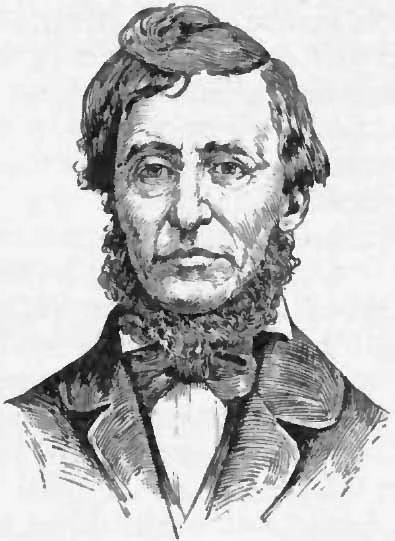
Illsutration of Thoreau from Appletons' Cyclopædia of American Biography (1889) (Wikimedia)
I’ve been dipping into Woolf’s essays again recently, as I work on an article about Night and Day. And re-read her commemorative essay on Henry David Thoreau, which was published as the lead article in The TLS in July 1917. I read it for the first time when I was working on my PhD and exploring Djuna Barnes’s difficult relationship with the American Transcendentalists. My sense then was that Woolf was highly suspicious of Thoreau’s anti-social tendencies. Some of my discussion of Woolf’s essay ended up in my book.
On re-reading the essay, I sense much more warmth and admiration from Woolf for Thoreau (albeit with some reservations). She praises his naturalness, his authenticity, his genius. She sees in him a gift of being able to see contemporary history according to distinctly non-anthropocentric scales of reference (what does the American Revolution look like from the perspective of the universe?). Yet at the same time she admires his anti-slavery politics, which she describes as demonstrating a ‘responsibility’ to his kind. It is also of its time (and reflects Woolf’s own racial prejudices), in that Thoreau is repeatedly likened to indigenous Americans who are, it is implied, also closer to nature.
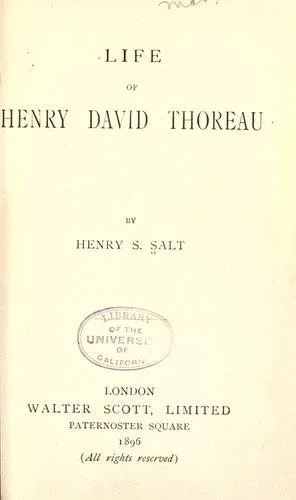
Henry Salt’s Life of Henry David Thoreau (1896) which Woolf cites in her essay.
Woolf was writing Night and Day at the time that she wrote this essay and it has made me wonder if there are elements of Thoreau in the character of Ralph Denham. Like Thoreau, he also wants to retreat to the country and is shown to have an affinity with nonhuman animals.
There’s also the question of ‘egotism’ that runs through Woolf’s novel. Thoreau is described as having an 'intense egoism' that people usually 'suffocate' in the interests of sociality. So rarely is a man 'an egoist on so ground a scale'. In Night and Day, Mary describes Katharine and Ralph as ‘egoists’, and is herself described in the same way later in the novel. Yet, this egotism, this inwardness, is revealed to be a kind of cosmological expansiveness. Gazing inward seems to lead in both Thoreau and Night and Day to a kind of productive inhuman perspective. Take this wonderful passage focalised through Katharine:
'Somehow, it seemed to her that they were even now beholding the procession of kings and wise men upon some road on a distant part of the earth. And yet, after gazing for another second, the stars did their usual work upon the mind, froze to cinders the whole of our short human history, and reduced the human body to an ape-like, furry form, crouching amid the brushwood of a barbarous clod of mud. This stage was soon succeeded by another, in which there was nothing in the universe save stars and the light of stars; as she looked up the pupils of her eyes so dilated with starlight that the whole of her seemed dissolved in silver and spilt over the ledges of the stars for ever and ever indefinitely through space. Somehow simultaneously, though incongruously, she was riding with the magnanimous hero upon the shore or under forest trees, and so might have continued were it not for the rebuke forcibly administered by the body, which, content with the normal conditions of life, in no way furthers any attempt on the part of the mind to alter them. She grew cold, shook herself, rose, and walked towards the house.’
And compare with this quotation from the Thoreau essay:
‘When we read his strong and noble books, in which every word is sincere, every sentence wrought as well as the writer knows how, we are left with a strange feeling of distance; here is a man who is trying to communicate but who cannot do it. His eyes are on the ground or perhaps on the horizon. He is never speaking directly to us; he is speaking partly to himself and partly to something mystic beyond our sight. […] All human intercourse as infinitely difficult; the distance between one friend and another was unfathomable; human relationships were very precarious and terribly apt to end in disappointment. But, although concerned and willing to do what he could short of lowering his ideals, Thoreau was aware that the difficulty was one that could not be overcome by taking pains.’